
Even though this is a grid-in question, we can actually plug-in to solve. That's because they don't ask us for the areas themselves, they ask us for the RATIO of the areas.
Say QS = 1, QV = 3, PT = 3, and PR = 4. That's going to mean that SV = 2, since it's the difference between QV and QS.
Our areas:
▵PST = ½(SV)(PT) = ½(2)(3) = 3
▵PQR = ½(QV)(PR) = ½(3)(4) = 6
So the ratio of ▵PST to ▵PQR = 3/6, or 1/2. You could also grid in .5.
Showing posts with label grid-in. Show all posts
Showing posts with label grid-in. Show all posts
1/13/11
Test 7 Section 3 - #18 (page 773)
This one's a huge pain, and before I get going on it I should stress that it's extremely unlikely that you will see something like this on your SAT...so don't spend too much time worrying about it. If you want to worry anyway...read on!

Test 7 Section 3 - #13 (page 772)
For this question, we'll start by just putting in the values they gave us: a = 2 and c = 3. So now the original equation reads:
2b + b = 2 + 2(3)
Do the multiplication first:2b + b = 2+6
...then add everything up:3b = 8
and finally, divide both sides by 3:b = 8/3
So your answer is 8/3 (or 2.66 or 2.67)!
12/9/10
2010 PSAT - Saturday - Section 4 (Math)
The following are TestTakers' suggestions for solving the problems on the October 16th, 2010 PSAT, Section 4 (a math section). Click "Read More" to view!
8/13/10
Test 6 Section 4 - #13 (page 716)
This would be a great backsolve if it were multiple choice. But it isn't, so we have to use another way. Blech.
We know the total cost was $600. We also know we have twice as many $1 bulbs as $2 bulbs. Think about that part for a second. If we have twice as many of the bulb that costs half as much, aren't we saying basically we paid the same for each? Shouldn't we have paid $300 for each kind of bulb? That's gonna mean 150 $2 bulbs, and 300 $1 bulbs. Total: 450 bulbs.
You could also approach this algebraically, if you want. Say x = # of cheap bulbs, and y = # of expensive ones. Solve these two equations:
x + 2y = 600 (this equation represents the cost)
x = 2y (this equation represents the fact that we had twice as many cheap ones, and if you tried this algebraically and got it wrong, this is likely where you made your mistake. Let me guess: your answer was 360?)
Solve it, and you get x = 300, y = 150. Total bulbs: 450, just like above.
4/30/10
Test 1 Section 7 - #17 (page 418)
They tell us these are overlapping equilateral triangles, and that CD, DE, and EF are all 10 inches long, so let's just fill in what we know first (the fact that they're equilateral and thus have angles that all equal 60° is very important here).

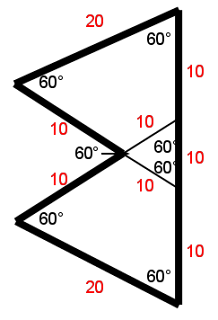

(This is totally not to scale. Sorry. Drawing with a mouse is hard!)
Note that the little triangle in the middle is also equilateral. We can use that to fill in all our distances. The bases of the big triangles (CE and DF on your diagram) are both 20, so all the sides of the big triangles will be 20. The smaller triangle will have sides of 10 inches each. That means we're cutting the overlapping sides in half:

To find our perimeter and finish the question, just count up all the sides that are bolded. They add up to 90.
Test 3 Section 5 - #15 (page 530)
This one's gonna get a little messy. Here's our starting point:
 Note that I've just gone ahead and put 40° in for x and 30° in for y. If we just work in the order they tell us things, we're going to scribble all over our diagram before we can fill in any actual NUMBERS for our angle measures. Instead, let's start with the last thing they tell us, since that'll allow us to start putting numbers in right away. If OB bisects angle AOD, then:
 Next, we can use the first thing they told us: OD bisects angle AOF. That means angle DOF is going to be 80 as well:
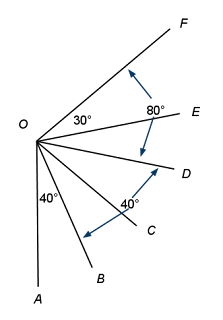 And now we're almost there. Since y was 30°, we know angle DOE is 50°, so fill that in. At this point, we kinda have everything we need. The question asked us for angle BOE, which has to be the sum of DOE (which we just figured out is 50°) and BOD (which we already know is 40°):


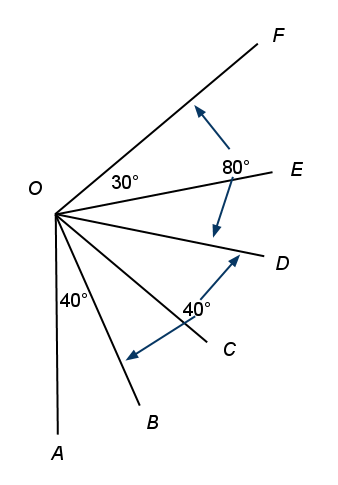

In this last diagram, I've also gone ahead and filled in all the other angles just for practice (based on what they tell us about OC bisecting AOE, which we actually don't need). Angle BOE is 90°.
4/29/10
Test 3 Section 5 - #16 (page 530)
Well, according to the way the problem is set up, we're going to have one "1", two "2"'s, three "3"'s, etc. We want to know when the first "12" will come. Well, that's going to come after the eleventh "11". Let's just count up how many terms will come first:
1 + 2 + 3 + 4 + 5 + 6 + 7 + 8 + 9 + 10 + 11 = 66
So if 66 terms come before the first "12", the first "12" will be the 67th term.
Test 3 Section 5 - #14 (page 529)
When the SAT spells out an equation in words instead of just giving it to you, it's usually going to be a very simple equation once you translate it. Most of the translating is pretty easy:
- "Five times a number" can be translated to "5n"
- "the number added to 5" can be translated to "n + 5"
- "is the same as" has to mean just "="
So we rewrite what they spelled out, and solve it:
5n = n + 5
4n = 5
n = 5/4 or 1.25
4/28/10
Test 3 Section 5 - #18 (page 530)


y = ax2
8 = a(4)2
8 = 16a
0.5 = a
This would, of course, also work with (-4,8). Either way, you're going to get 0.5 (or 1/2) for a.
4/26/10
Test 1 Section 7 - #16 (page 418)
This question is a pain. The thing you have to remember to make it easier is that W, X, Y, and Z all have to be integers between 0 and 9 for this to work. Let's look at the rules (and what they tell us):
X = W + Y + Z -- This tells us X has to be the biggest number.
W = Y + 1 -- This one's obvious: W is bigger than Y, but only by 1.
Z = W - 5 -- This one tells us a LOT, because the lowest Z can be is 0.
Let's start putting things together. Because of the third rule, we know W is either 5, 6, 7, 8, or 9 (otherwise Z would be negative). But it can't be too big, because the second rule says W is only 1 bigger than Y, and the first rule says X equals the sum of all the other letters. Confused yet? If so, do a little guess and check with possibilities for W to see what happens to the other values.
Here's what I'm coming up with:
W = 5. Why? Because if it was any bigger, like 6, Y would also be bigger, like 5 ( because of the second rule), so X would be bigger than 9 (by the first rule), which can't happen. Once you've got W, the rest sorta fall into place.
Y = 4. Why? Because W = 5 and the second rule tells us Y is one less.
Z = 0. Why? Because W = 5 and the second rule tells us W - 5 = Z.
X = 9. Why? Because the first rule tells us that X is the sum of all the others and 5 + 4 + 0 = 9
Our WXYZ number is 5940.
Test 1 Section 7 - #14 (page 417)
Set up a hangman-like set of blanks so that you can fill them in as you go:
__, __, __, __, __, __, __, __
Now, start to fill in what you know (the third and the sixth numbers):
__, __, 17, __, __, 77, __, __
When the question says the difference between two consecutive terms is always the same number, that means that we're counting up by that number (say we were counting by 2's, we'd have 2, 4, 6, 8, etc.). What are we counting up by here? How do we get from 17 to 77 in 3 steps? We count up by 20's:
__, __, 17, 37, 57, 77, __, __
So all we need to do now is find what they asked for: the 8th term.
__, __, 17, 37, 57, 77, 97, __
__, __, 17, 37, 57, 77, 97, 117
The eighth term is 117.
Test 1 Section 7 - #11 (page 417)
If they're telling us she has a 2/5 probability of picking a brown towel, we can think of 2/5 as the ratio of brown towels to all the rest of the towels in her closet. Since they tell us she has 6 brown towels, we can set up a proportion to solve for the total towels:


Cross multiply to solve, and you'll see she has x = 15 total towels.
4/19/10
Test 7 Section 3 - #17 (page 773)
See variables, think PLUG-IN, sometimes even in the grid-in section! Pick 3 prime numbers greater than 2:
Now just do what the problem asks: 3 x 5 x 7 = 105. How many factors does 105 have (including 1 and 105)?
Any more? Nope. That's 8 factors.
3, 5, 7
Now just do what the problem asks: 3 x 5 x 7 = 105. How many factors does 105 have (including 1 and 105)?
1 x 10⁵
3 x 35
5 x 21
7 x 15
Test 7 Section 3 - #16 (page 773)
Note: Pretty much any time you have a shaded region problem, you should be thinking about it in 3 parts, arranged into this equation:

In this particular question, we're going to need to do a little work before we can use that, and then a teensie bit more once we have. We already know the shaded region's area is 64π. We know the smaller circle has a radius of 6, so we can use A = πr2 to find the area of that inner circle (the UNSHADED part) to be 36π.
Put those into the equation above and you get:
So the area of the WHOLE THING is 100π. Use A = πr2 one more time now to find the radius of the large circle:
In this particular question, we're going to need to do a little work before we can use that, and then a teensie bit more once we have. We already know the shaded region's area is 64π. We know the smaller circle has a radius of 6, so we can use A = πr2 to find the area of that inner circle (the UNSHADED part) to be 36π.
Put those into the equation above and you get:
64π + 36π = 100π
So the area of the WHOLE THING is 100π. Use A = πr2 one more time now to find the radius of the large circle:
100π = πr2
100 = r2
10 = r
Test 7 Section 3 - #15 (page 773)
Honestly, when I'm faced with questions like this I just start listing and counting. If you stay organized, you'll get this question right in not much time, and you won't have to worry about any equations.
I'm going to number the 4 experienced plumbers 1, 2, 3, and 4, and then the trainees 5, 6, 7, and 8. Then I'm just going to follow the instructions in the problem (1 experienced plumber and 2 trainees) and see if I can recognize the pattern that emerges before I count up every combination.
Start with experienced plumber #1. He can be accompanied by the following sets of trainees:
Remember, "5, 6" is the same as "6, 5" in this question, since in both cases trainees 5 and 6 will be accompanying experienced plumber 1.
OK, now what trainees can accompany experienced plumber #2?
I'm going to number the 4 experienced plumbers 1, 2, 3, and 4, and then the trainees 5, 6, 7, and 8. Then I'm just going to follow the instructions in the problem (1 experienced plumber and 2 trainees) and see if I can recognize the pattern that emerges before I count up every combination.
Start with experienced plumber #1. He can be accompanied by the following sets of trainees:
5, 6
5, 7
5, 8
6, 7
6, 8
7, 8
Remember, "5, 6" is the same as "6, 5" in this question, since in both cases trainees 5 and 6 will be accompanying experienced plumber 1.
OK, now what trainees can accompany experienced plumber #2?
5, 6
5, 7
5, 8
6, 7
6, 8
7, 8
The SAME ONES. Once we see the pattern, we don't need to finish listing. There are 6 possible combinations of trainees for each of 4 experienced plumbers. (6)(4) = 24. That's 24 possible combinations.
Test 7 Section 3 - #12 (page 772)

The question tells us that the perimeter of rectangle PQRS is 10. A quick look at the graph tells us that PS = 2. We know QR = 2 too, since that's how rectangles work. In order for our perimeter to be 10, then, we know that PQ and RS both have to be equal to 3. We can use these lengths to figure out points Q and R, and now we're almost done:

y = ax2
3 = a(1)2 (substitute point R in for x and y)
3 = a
Test 7 Section 3 - #9 (page 771)
This one is just straight algebra. As is often the case with the grid-in questions, we don't have the option of using plug-in or backsolve.
2(x - 3) = 8 (what we're given)
x - 3 = 4 (divide both sides by 2)
x = 7 (add 3 to both sides)
Now we just need to put 7 in for x in the expression:
(x - 3)/(x + 3)
(7 - 3)/(7 + 3) (substitute 7 for x)
4/10
We can grid in our answer as 0.4, 4/10, 2/5, etc. Me? I prefer to use decimals.
4/14/10
Test 2 Section 5 - #14 (page 468)
Tough one (grid-ins usually are). The solution to this one, though, can be found by PLUGGING IN (with a little BACKSOLVE flavor added in for good measure)! Just start by trying any number for x. How about x = 3? Just to be clear, we're looking for f(3) to be LESS THAN 3 (that's what they say in the question: f(a) < a).
Ok, so that didn't work; 8 is not less than 3. But here's where that BACKSOLVE flavor comes in: now we have a better idea of how the pieces fit together. We want x to get a little bigger, so that 3x gets closer to 17. That way, f(x) will be small. Why not try x = 5 next?
GREAT! 2 < 5, so x = 5 works! (A few other numbers will work too: anything between 4.25 and 8.5...though you'd probably be best to stick with integers and just try 5, 6, or 7.)
f(x) = |3x - 17|
f(3) = |3(3) - 17|
f(3) = |9-17|
f(3) = |-8|
f(3) = 8
Ok, so that didn't work; 8 is not less than 3. But here's where that BACKSOLVE flavor comes in: now we have a better idea of how the pieces fit together. We want x to get a little bigger, so that 3x gets closer to 17. That way, f(x) will be small. Why not try x = 5 next?
f(5) = |3(5) - 17|
f(5) = |15-17|
f(5) = |-2|
f(5) = 2
GREAT! 2 < 5, so x = 5 works! (A few other numbers will work too: anything between 4.25 and 8.5...though you'd probably be best to stick with integers and just try 5, 6, or 7.)
Test 2 Section 5 - #16 (page 468)
For questions like this, it's best to just start listing the numbers that are "tri-factorable" (by listing numbers that are made by multiplying 3 consecutive positive integers, starting with the lowest positive integers we can). It won't take us long:
1 x 2 x 3 = 6
2 x 3 x 4 = 24
3 x 4 x 5 = 60
4 x 5 x 6 = 120
5 x 6 x 7 = 210
6 x 7 x 8 = 336
7 x 8 x 9 = 504
8 x 9 x 10 = 720
9 x 10 x 11 = 990
10x11x12 = 1320 (Oops, too high!)
So how many were under 1000? 9 of them.
1 x 2 x 3 = 6
2 x 3 x 4 = 24
3 x 4 x 5 = 60
4 x 5 x 6 = 120
5 x 6 x 7 = 210
6 x 7 x 8 = 336
7 x 8 x 9 = 504
8 x 9 x 10 = 720
9 x 10 x 11 = 990
So how many were under 1000? 9 of them.
Subscribe to:
Posts (Atom)

 Posts


