Showing posts with label BACKSOLVE. Show all posts

11/3/11

Test 8 Section 9 - #16 (page 861)

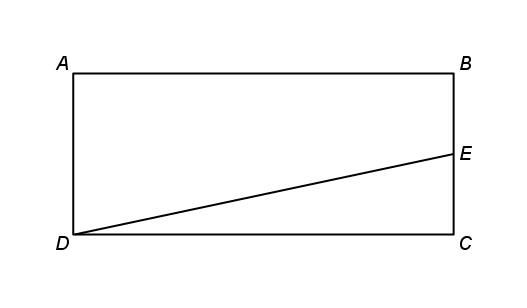
Tough one, right?  Let's start by drawing it:
So the area of ABED is 2/3. We don't have an equation for the area of a shape like that, so let's see if draw a few more lines and see if anything becomes more clear. I'm gonna draw a few more segments, and name another point, P, which is the midpoint of AD.
Alright, now we're doing it. Notice that ABED, which we know, is 3/4 of ABCD, which we want.

ABED, which has an area of 2/3, is 3/4 of what we want. Confusing, right? At this point, you can mess with the fractions*, or you can backsolve. Look at the choices. 3/4 of one of them is going to be 2/3.

Of course, when we backsolve, we start with (C):

(C) (8/9)(3/4) = 24/36 = 2/3. 

Nice. Done already. :)

* To "mess with" the fractions, divide 2/3 by 3/4. You get 8/9. 

5/17/11

Test 4 Section 9 - #1 (page 609)

You can backsolve this one. Start with (C): If there are 8 girls on the bus, that means that there were 8 boys on the bus to start as well.

At the first stop, 4 boys got off and nobody got on, so now there are 4 boys on the bus and still 8 girls.

That's twice as many girls as there are boys (just like the question says) so (C) is our answer.

3/8/11

Test 8 Section 7 - #17 (page 851)

We can BACKSOLVE this. It's weird that they spell out the numbers in the answer choices instead of just using numerals, but it doesn't matter.

Start with (C). If it's 3 years, then


should be equal to 3200. But is that true? No, it's 2560! That's too small...which means (and this is the tricky part) that we need to go in the direction of fewer years. Remember that the car is LOSING value over time, so if it's already too low, that means he's had it for too long.

So we try (B). If its 2 years, then 


should be 3200, and that IS true! (B) is our answer. 

Note: depending on which edition of the Blue Book you have, the printed answer in the key is WRONG on this one. I promise you that the answer is (B), but your book might say it's (C). My book does. Look at the very first page and hopefully you'll have a yellow sheet that makes all the silly corrections they forgot to make before they printed the book. If not, click the link in this paragraph to see for yourself.

12/9/10

2010 PSAT - Saturday - Section 4 (Math)

The following are TestTakers' suggestions for solving the problems on the October 16th, 2010 PSAT, Section 4 (a math section). Click "Read More" to view!


12/7/10

2010 PSAT - Saturday - Section 2 (Math)

The following are TestTakers' suggestions for solving the problems on the October 16th, 2010 PSAT, Section 2 (a math section). Click "Read More" to view!

8/13/10

Test 6 Section 4 - #6 (page 713)

This one is a backsolve.  We have to look at the answer choices, and figure out which one has 3 integer factors: itself, its square root, and 1.  Since EVERY choice is going to have the factors 1 and itself, we're basically looking to see which ones are perfect squares, and then see which don't have any other factors.  

Start by eliminating 33.  That's not a perfect square.  Then eliminate 64 and 100, because they're even, so they're definitely going to have 2 as a factor.  Then you're down to 121 and 81.

121 is 112, and 81 is 92.  Can you think of any factors of 121 other than 1, 11, and 121?  No?  How about 81?  Any factors other than 1, 9, and 81?  How about 3?  Yep, 3 is also a factor, so we can eliminate 81.  We're left with only 121.  Choice A.

4/28/10

Test 3 Section 5 - #8 (page 527)

You can BACKSOLVE this one.  Start with (C), which says m = 24.  If that's true, then:
(x - 8)(x - k) = x2 - 5kx + 24
You know from all the factoring/FOILing you've ever done in school that k has to be 3, because (-8)(-3) = 24.  But does that work with the rest of the equation?  Test, substituting 3 in for k: 
(x - 8)(x - 3) = x2 - 5(3)x + 24
x2 - 11x + 24 = x2 - 15x + 24
EEK!  When you FOIL out the left hand side, it doesn't work!

So do the same process now, using (B)* instead, which says x = 16:
(x - 8)(x - k) = x2 - 5kx + 16
Using the same logic we just used above, we know k has to be 2, since (-8)(-2) = 16.  Test it, using 2 for k:
(x - 8)(x - 2) = x2 - 5(2)x + 16
x2 - 10x + 16 = x2 - 10x + 16
Everything matches up this time!  (B) must be our answer!

* How do we know to try (B) next instead of (D), you ask?  Well, basically looking at how -5(3) = 15 was BIGGER than -8 - 3 = -11, and realizing that those numbers are only going to get further away from each other if our answer gets bigger.  This is a bit persnickety to explain, but the good news is if you try (D), you'll see very quickly that it didn't work and you got further away, so you'll know to try (B) next.  

4/26/10

Test 1 Section 3 - #15 (page 400)

I love this question because it's susceptible to multiple techniques.  GUESSTIMATE makes the most sense:

You know this slope is negative just from looking at it: it goes down from left to right.  So that leaves us with only (A) and (B) before we even look very closely.  When we do look more closely, we can tell that this slope isn't very steep...its run is bigger than its rise, if you will.  The only answer that really makes sense is (B): -1/2.

Let's confirm that by putting our answer back into the question.  This is the other way we could have solved it, BACKSOLVE (using the slope formula).

Slope is rise over run, or:
We're luck here that our line goes through the origin, so we can replace y1 and x1 with 0.  Basically, we're looking, then, for an answer choice in the form of y/x that fits our diagram at point A.  Again, we're basically back to guesstimating here, in that the way we make our decision is that (-2,1) looks more like point A than (-1,2) does.  Either way, our answer is (B).

Test 1 Section 3 - #9 (page 398)

When you have a number line, and you need to figure out what a particular tick mark represents, the first step is to figure out the range (how much ground is being covered), and how many parts it's being divided into.

On this line, we're covering all the ground between 2 and 42, or a distance of 40.  How many parts are we dividing 40 into? I'll use red numbers to count:
So if a distance of 40 is divided evenly 5 times, then each tick mark must be 8, right?  So x has to be 18.  Let's fill in all the ticks (in green numbers) just to make sure our pattern fits:

Yup, looks good!  Answer (D).


Note: Technically you could backsolve here, too.  Start by trying (C), which says x is 16.  If that's true, then the tick mark before it has to be 9 (halfway between 2 and 16).  Then you fill in all the ticks to make sure your patten fits, but it doesn't.  You get 2, 9, 16, 23, 30, and a 37 where the 42 should be.  You're short by a few by the time you get to 42, so you need to try a bigger number to start with.  (D) of course still works.

4/14/10

Test 2 Section 5 - #6 (page 464)

The key here is recognizing that slope = rise/run (or, in this question, y/x).  According to this question the slope of that ramp is 7/16.  We can actually BACKSOLVE this one, by basically taking our answers and plugging them into rise/run (or, like we said, y/x) to see which one will give us that same fraction.  We know our rise (or y) is 3.5 feet.  With backsolve, always try (C) first:

(C) 3.5/20 = 7/40.  Nope.  Way too long on bottom.  Go smaller.
(B) 3.5/12.5 = 7/25.  Still too long on bottom, but getting warmer...
(A) 3.5/8 = 7/16.  BINGO.

Test 2 Section 5 - #14 (page 468)

Tough one (grid-ins usually are). The solution to this one, though, can be found by PLUGGING IN (with a little BACKSOLVE flavor added in for good measure)! Just start by trying any number for x. How about x = 3? Just to be clear, we're looking for f(3) to be LESS THAN 3 (that's what they say in the question: f(a) < a).

f(x) = |3x - 17|
f(3) = |3(3) - 17|
f(3) = |9-17|
f(3) = |-8|
f(3) = 8

Ok, so that didn't work; 8 is not less than 3. But here's where that BACKSOLVE flavor comes in: now we have a better idea of how the pieces fit together. We want x to get a little bigger, so that 3x gets closer to 17.  That way, f(x) will be small.  Why not try x = 5 next?

f(5) = |3(5) - 17|
f(5) = |15-17|
f(5) = |-2|
f(5) = 2

GREAT! 2 < 5, so x = 5 works! (A few other numbers will work too: anything between 4.25 and 8.5...though you'd probably be best to stick with integers and just try 5, 6, or 7.)

Test 2 Section 5 - #15 (page 468)


This one has hints of PLUGiIN and BACKSOLVE, even though it's a grid-in! We don't need any of that stuff about how many candies are in the jar...that's just extraneous information. All we need to know is where Ari's starting from (3 red, 4 green) and how many more he takes. We want him to have more red pieces than green pieces by the end, but just barely. Here's how I set it up:

REDGREENComments
34This is our starting point.
+7+6Just plugging in 2 numbers that are close together and add up to 13.
=10=10OOPS!  That's not enough red...Ari has the same amount of each color now.

Now it's kinda clear where to go: add one more red (and one less green):

REDGREENComments
34This is our starting point (again).
+8+5Plug in new numbers.
=11=9That'll do it!  Any less red and he'd have the same number of each (as we saw above).

12/3/09

Test 10 Section 8 - #15 (page 981)

Holy cow.  Before we do anything else, let's clean this up a bit.  Remember, this is a #15 out of 16, so we often have to do a little legwork before we really get busy.

The first thing you want to do is cancel out that pesky extra n (I'm gonna show you my sloppy handwriting for this one since we're dealing with big fractions).  That'll get you:

Combine everything (note that you don't HAVE to FOIL if you don't want, since we've got the factored version of Difference of Two Squares):

Now, the numerators on either side are basically telling us that n = 5.  Well, then n2 is 25, and [n2 - 1] (our denominator) is 24.   Answer choice C says k is 24, and that's our answer.

Note that this also could technically have been a BACKSOLVE question, although not the easiest one. If you jumped to the answer choices once you simplified you'd start with C, which says k is 24, and you'd figure out what n would have to be to make [n2 - 1] = 24.  So long as your n is an integer (which 5 of course is), you're good to go.